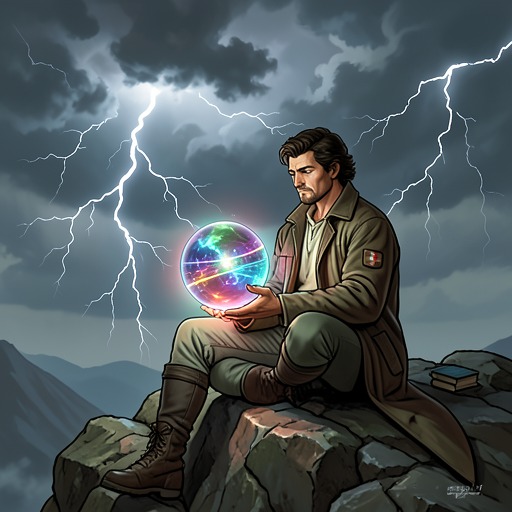
Cephalon Collective Consciousness
The Last JediThe Cephalon Collective Consciousness is a network of joined minds whose severance turns shared existence into profound isolation. The novel reveals its nature through the cost of Darth Ramage’s theft: in taking knowledge of time manipulation from Cephalon victims, he also cut them off from their collective consciousness, leaving individuals alone in what had been a connected temporal expanse. Jax Pavan’s realization makes the network more than an abstract mental structure; it is a form of relation whose destruction is itself a wound.
Nature and Structure
The Cephalons’ consciousness is described as a network of joined consciousness, connecting individuals rather than merely storing information in a common place. The evidence does not specify the network’s mechanics or the ordinary experience of participating in it. It does establish the essential contrast: membership means being joined to others, while separation leaves each individual horrifically alone. The collective is therefore both a way of being connected and a condition that can be violently taken away.
A phrase embedded in the knowledge Jax encounters compares islands and currents: islands do not move unless the currents move them. Its appearance gives the network a relational image. An individual is not represented as wholly self-moving and self-contained; movement depends on currents that exceed the separate island. Jax recognizes the thought as having the texture of one of Aoloiloa’s mystical pronouncements, linking the newly acquired insight to a language of interconnected forces without resolving exactly what Aoloiloa knew or intended.
Ramage’s Violation
The network’s destruction is bound to Darth Ramage’s pursuit of knowledge about time manipulation. Jax realizes that this knowledge came at the expense of Cephalon lives and minds: Ramage ripped an understanding of time in its extended dimensions from his victims. The theft was not simply the taking of information. In the same process, Ramage cut the victims off from their shared consciousness, so that the acquisition of knowledge and the infliction of isolation form one act of violence.
The scale remains uncertain but appalling. Jax thinks that the victims numbered hundreds, perhaps thousands; the text does not settle on a precise count. That uncertainty does not lessen the consequence. The loss is described from the victims’ side as separation from a joined network and from Jax’s perception as echoes of agony in the interstices between visualization and articulation. Those echoes indicate how the violation registers in the knowledge he has received, but they do not make him one of the original victims or establish that he can restore their connection.
Jax’s Recognition
When the embedded thought about islands and currents flickers through Jax’s mind, he understands with horrible certainty what Ramage’s knowledge has cost. The realization arrives as part of the knowledge itself: his response is not a detached deduction about an unknown historical event, but recognition accompanied by perceived echoes of suffering. The collective consciousness becomes legible to him through the very fact of its rupture.
Jax considers whether Aoloiloa must have known what Ramage had done. He wonders whether Aoloiloa foresaw that the knowledge would help him, or whether it was intended to be useful to someone else. The question remains open. What is clear is the danger attached to Jax’s possession of it: he imagines the consequences if Darth Vader—or Palpatine—were to get hold of him. He tries to pull his consciousness away from the knowledge, but the attempt comes too late. It is fixed in him like a hot, red star, and when he closes his eyes, the library vanishes.
Significance
The concept joins three consequences that the narrative keeps distinct but inseparable: Ramage gains knowledge, Cephalon victims lose their connection, and Jax inherits knowledge that he cannot simply put aside. The network’s significance lies in this imbalance. A capability acquired by one agent is purchased through damage to many minds, and the resulting insight carries traces of that damage into another person’s consciousness.
The phrase Separation destroys us expresses the stakes of the severance without explaining away its material cost. The victims are not merely absent from one another; they are left isolated after belonging to a shared network. Jax’s response, meanwhile, makes the revelation a present danger as well as an account of past harm: the knowledge is now lodged in him, and he fears what Vader or Palpatine might do if they obtained access to it. The collective consciousness thus becomes the measure of what Ramage’s extraction has broken and the source of a burden Jax cannot undo by withdrawing from the thought.